


Page 20 - Essentia Vol 5 Issue 1
P. 20
VOL V | ISSUE I | 5 AUGUST 2026            VOL V | ISSUE I | 5 AUGUST 2026
              A BIANNUAL NEWSLETTER OF ASSAM CANCER CARE FOUNDATION                                                                                                                                              A BIANNUAL NEWSLETTER OF ASSAM CANCER CARE FOUNDATION


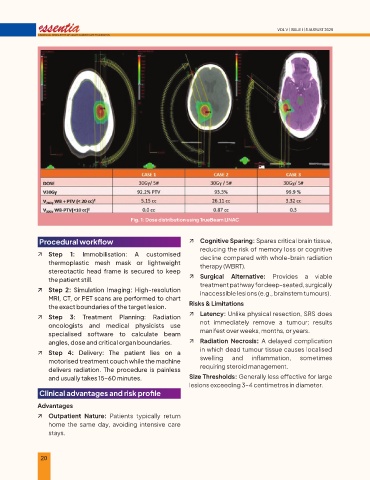
                                            Fig. 1: Dose distribution using TrueBeam LINAC


              Procedural workflow                                  Ê  Cognitive Sparing: Spares critical brain tissue,

                 Ê  Step   1:   Immobilisation:   A   customised   reducing the risk of memory loss or cognitive
                                                                   decline  compared  with  whole-brain  radiation
                 thermoplastic  mesh  mask  or  lightweight        therapy (WBRT).
                 stereotactic  head  frame  is  secured  to  keep
                 the patient still.                                Ê  Surgical   Alternative:  Provides  a  viable
                 Ê  Step  2:  Simulation  Imaging:  High-resolution   treatment pathway for deep-seated, surgically
                                                                   inaccessible lesions (e.g., brainstem tumours).
                 MRI, CT, or PET scans are performed to chart
                 the exact boundaries of the target lesion.     Risks & Limitations

                 Ê  Step   3:  Treatment  Planning:  Radiation     Ê  Latency:  Unlike  physical  resection,  SRS  does
                 oncologists  and  medical  physicists  use        not  immediately  remove  a  tumour;  results
                 specialised  software  to  calculate  beam        manifest over weeks, months, or years.
                 angles, dose and critical organ boundaries.       Ê  Radiation  Necrosis:  A  delayed  complication
                 Ê  Step  4:  Delivery:  The  patient  lies  on  a   in which dead tumour tissue causes localised
                 motorised treatment couch while the machine       swelling   and   inflammation,   sometimes
                 delivers  radiation.  The  procedure  is  painless   requiring steroid management.
                 and usually takes 15–60 minutes.               Size Thresholds: Generally less effective for large
                                                                lesions exceeding 3–4 centimetres in diameter.
              Clinical advantages and risk profile

             Advantages
                 Ê  Outpatient  Nature:  Patients  typically  return
                 home  the  same  day,  avoiding  intensive  care
                 stays.


              20                                                                                                                                                                                                                      21

