


Page 12 - Essentia Vol 5 Issue 1
P. 12
VOL V | ISSUE I | 5 AUGUST 2026            VOL V | ISSUE I | 5 AUGUST 2026
              A BIANNUAL NEWSLETTER OF ASSAM CANCER CARE FOUNDATION                                                                                                                                              A BIANNUAL NEWSLETTER OF ASSAM CANCER CARE FOUNDATION

             Plastic Surgeon’s
             Role in

             Oncology                                                            Dr Tushar Dutta

                                                                                 Consultant, Oncoplastic Surgeon
             Services                                                            State Cancer Institute, Guwahati


                  he role of plastic and reconstructive surgery   surgery,  followed  where  indicated  by  adjuvant
                  in oncology is often misunderstood. For many   radiation or systemic therapy. In this chain of care,
             Tpeople, plastic surgery still means cosmetic      plastic  surgeons  do  more  than  restore  removed
             surgery.  In  reality,  cosmetic  work  is  only  a  small   tissue.  They  help  wounds  heal  better  and  faster,
             part  of  a  much  wider  problem-solving  speciality.   making  it  possible  for  patients  to  begin  the  next
             The  scope  of  plastic  surgery  extends  from  hand   stage of treatment on time.
             surgery, diabetic foot care, cleft and craniofacial   Reconstructive  surgery  is  therefore  not  an
             surgery,  burns  and  maxillofacial  trauma  to  onco-  afterthought  in  oncology.  It  is  an  essential  part
             reconstruction,  lymphoedema  management  and      of  treatment  that  supports  survival,  function  and
             other  evolving  areas  of  care.  The  older  idea  that   quality of life. A cancer diagnosis naturally triggers
             plastic surgeons operate from “head to toe” has, in   fear  and  a  strong  desire  to  remove  the  tumour
             practice, expanded to “hair to nail”.              as  quickly  as  possible.  Earlier,  when  cancer  was

             This  distinction  becomes  especially  important   viewed almost as a death sentence, surgery often
             in  the  Northeast,  where  the  cancer  burden  is   focused  only  on  removing  disease,  with  limited
             considerable,  particularly  in  head  and  neck   attention  to  the  disfigurement  or  disability  that
             malignancies.  Cancers  of  the  breast,  soft  tissue,   followed. Many patients were left unable to speak,
             limbs and trunk are also being seen with increasing   swallow,  walk  comfortably  or  appear  in  public
             frequency.  Treatment  often  involves  ablative   without distress.


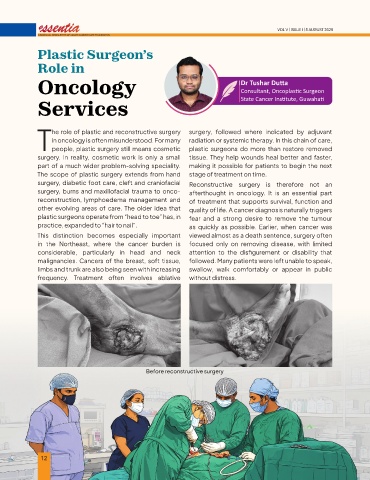
                                                 Before reconstructive surgery


              12                                                                                                                                                                                                                      13

