


Page 14 - Essentia Vol 5 Issue 1
P. 14
VOL V | ISSUE I | 5 AUGUST 2026            VOL V | ISSUE I | 5 AUGUST 2026
              A BIANNUAL NEWSLETTER OF ASSAM CANCER CARE FOUNDATION                                                                                                                                              A BIANNUAL NEWSLETTER OF ASSAM CANCER CARE FOUNDATION

             When in Doubt, Check it out

             Understanding

             Skin Cancer


                                       Dr Swastika Debbarma
                                       Consultant, Dermatologist
                                       MBBS, MD (DVL)


                   our skin is your body’s largest organ — and
                   often  the  most  neglected.  When  people
             Ythink  about  cancer,  they  picture  the  lungs,
             breast,  stomach  or  colon.  But  skin  cancer  is  one
             of  the  most  common  cancers  worldwide,  yet  it
             remains under-recognised and underestimated.

              What is skin cancer?
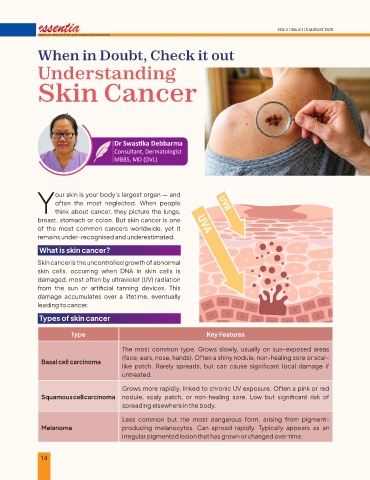
             Skin cancer is the uncontrolled growth of abnormal
             skin  cells,  occurring  when  DNA  in  skin  cells  is
             damaged, most often by ultraviolet (UV) radiation
             from  the  sun  or  artificial  tanning  devices.  This
             damage  accumulates  over  a  lifetime,  eventually
             leading to cancer.

              Types of skin cancer

                         Type                                        Key Features

                                         The  most  common  type.  Grows  slowly,  usually  on  sun-exposed  areas
                                         (face, ears, nose, hands). Often a shiny nodule, non-healing sore or scar-
               Basal cell carcinoma
                                         like  patch.  Rarely  spreads,  but  can  cause  significant  local  damage  if
                                         untreated.

                                         Grows more rapidly, linked to chronic UV exposure. Often a pink or red
               Squamous cell carcinoma   nodule,  scaly  patch,  or  non-healing  sore.  Low  but  significant  risk  of
                                         spreading elsewhere in the body.

                                         Less  common  but  the  most  dangerous  form,  arising  from  pigment-
               Melanoma                  producing  melanocytes.  Can  spread  rapidly.  Typically  appears  as  an
                                         irregular pigmented lesion that has grown or changed over time.


              14                                                                                                                                                                                                                      15

