


Page 86 - Essentia Vol 5 Issue 1
P. 86
VOL V | ISSUE I | 5 AUGUST 2026            VOL V | ISSUE I | 5 AUGUST 2026
              A BIANNUAL NEWSLETTER OF ASSAM CANCER CARE FOUNDATION                                                                                                                                              A BIANNUAL NEWSLETTER OF ASSAM CANCER CARE FOUNDATION

             balancing legal requirements with patient privacy.
             This careful approach protects both patients and
             the institution.

              Statistical analysis and institutional
              learning
             Beyond  individual  patient  care,  an  effective
             MRD  generates  institutional  statistics,  including
             case  volume,  treatment  distribution,  outcomes,
             complication  patterns  and  compliance  with
             treatment   guidelines.   These   data   support   agencies,  international  cancer  organisations  and
             performance  reports,  benchmarking,  academic     research  bodies  requires  standardised  data  on
             research,  publication,  strategic  planning  and   cancer  cases,  outcomes  and  adverse  events.
             resource  allocation.  At  SCI  Guwahati,  the  MRD   Research,  innovation,  regulatory  compliance
             systematically   collects   such   statistics   for   and  ethical  practice  all  depend  on  the  quality,
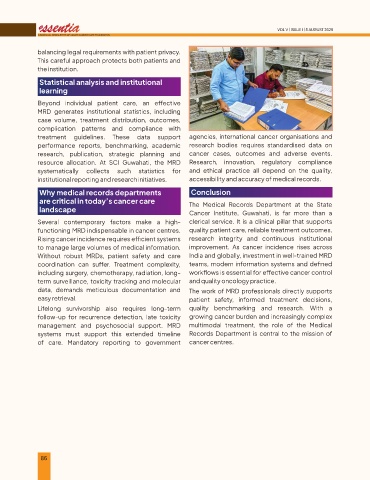
             institutional reporting and research initiatives.  accessibility and accuracy of medical records.

              Why medical records departments                   Conclusion
              are critical in today’s cancer care               The  Medical  Records  Department  at  the  State
              landscape                                         Cancer  Institute,  Guwahati,  is  far  more  than  a

             Several  contemporary  factors  make  a  high-     clerical  service.  It  is  a  clinical  pillar  that  supports
             functioning MRD indispensable in cancer centres.   quality patient care, reliable treatment outcomes,
             Rising cancer incidence requires efficient systems   research  integrity  and  continuous  institutional
             to manage large volumes of medical information.    improvement.  As  cancer  incidence  rises  across
             Without  robust  MRDs,  patient  safety  and  care   India and globally, investment in well-trained MRD
             coordination  can  suffer.  Treatment  complexity,   teams,  modern  information  systems  and  defined
             including surgery, chemotherapy, radiation, long-  workflows is essential for effective cancer control
             term  surveillance,  toxicity  tracking  and  molecular   and quality oncology practice.
             data,  demands  meticulous  documentation  and     The  work  of  MRD  professionals  directly  supports
             easy retrieval.                                    patient  safety,  informed  treatment  decisions,

             Lifelong  survivorship  also  requires  long-term   quality  benchmarking  and  research.  With  a
             follow-up  for  recurrence  detection,  late  toxicity   growing cancer burden and increasingly complex
             management  and  psychosocial  support.  MRD       multimodal  treatment,  the  role  of  the  Medical
             systems  must  support  this  extended  timeline   Records  Department  is  central  to  the  mission  of
             of  care.  Mandatory  reporting  to  government    cancer centres.


              86                                                                                                                                                                                                                      87

