


Page 27 - Essentia Vol 5 Issue 1
P. 27
VOL V | ISSUE I | 5 AUGUST 2026  VOL V | ISSUE I | 5 AUGUST 2026
 A BIANNUAL NEWSLETTER OF ASSAM CANCER CARE FOUNDATION                                 A BIANNUAL NEWSLETTER OF ASSAM CANCER CARE FOUNDATION


             Stars, Sugar


             and Sea Gods


             Fascinating Names

             in Oncopathology
                                                                                         Dr Munmun Harlalka
                                                                                         Consultant, Pathologist
                                                                                         Barpeta Cancer Centre


             A case-based journey through                       the  uterus,  replacing  the  endometrium  with
             oncopathology’s most memorable                     dysplastic  squamous  epithelium  and  producing
             names.                                             the  characteristic  “Zuckerguss”  pattern.  Tumour
                   athology  is  rich  in  colourful  terminology   cells were positive for Pax8 and p16, while ER and
                   that  turns  microscopic  observations  into   PR were negative.
             Pmemorable  imagery.  From  a  “starry  sky”
             and a “sugar-iced” tumour to a neoplasm named
             after  a  mythological  sea  god,  these  evocative
             descriptors  aid  recognition  of  rare  entities  and
             complex morphological patterns. Presented here
             are  four  cases  from  our  practice  that  reveal  the
             stories  behind  some  of  oncopathology’s  most
             intriguing names.
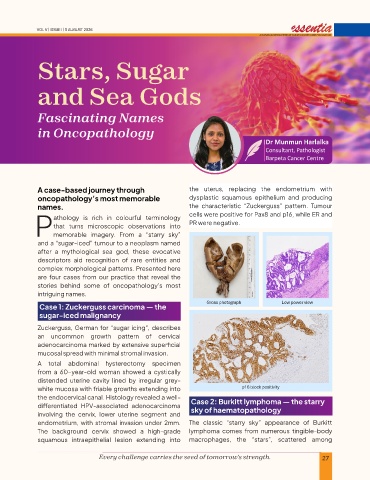
                                                                     Gross photograph         Low power view
              Case 1: Zuckerguss carcinoma — the
              sugar-iced malignancy

             Zuckerguss,  German  for  “sugar  icing”,  describes
             an  uncommon  growth  pattern  of  cervical
             adenocarcinoma  marked  by  extensive  superficial
             mucosal spread with minimal stromal invasion.
             A  total  abdominal  hysterectomy  specimen
             from  a  60-year-old  woman  showed  a  cystically
             distended  uterine  cavity  lined  by  irregular  grey-
             white mucosa with friable growths extending into                    p16 block positivity
             the endocervical canal. Histology revealed a well-
             differentiated  HPV-associated  adenocarcinoma     Case 2: Burkitt lymphoma — the starry
             involving  the  cervix,  lower  uterine  segment  and   sky of haematopathology
             endometrium,  with  stromal  invasion  under  2mm.   The  classic  “starry  sky”  appearance  of  Burkitt
             The  background  cervix  showed  a  high-grade     lymphoma  comes  from  numerous  tingible-body
             squamous  intraepithelial  lesion  extending  into   macrophages,  the  “stars”,  scattered  among


 26                               Every challenge carries the seed of tomorrow’s strength.                  27

