


Page 31 - Essentia Vol 5 Issue 1
P. 31
VOL V | ISSUE I | 5 AUGUST 2026  VOL V | ISSUE I | 5 AUGUST 2026
 A BIANNUAL NEWSLETTER OF ASSAM CANCER CARE FOUNDATION                                 A BIANNUAL NEWSLETTER OF ASSAM CANCER CARE FOUNDATION
             geographic  variation.  The  Northeast  carries  a   per 100,000 stood in sharp contrast to Dibrugarh
             burden  that  is  disproportionate  to  its  population   district in Assam, which reported one of the lowest
             share.  This  review  therefore  focuses  on  what  the   rates  nationally  at  4.91  per  100,000,  illustrating
             region  needs  from  its  screening  programme  and   substantial intra-regional variation as well.
             why  stronger  diagnostic  follow-up  is  essential  in   The  human  cost  of  this  burden  is  compounded
             routine practice.                                  by  survival  disparities.  A  multi-registry  analysis
                                                                of  11  population-based  cancer  registries  found
              The disproportionate burden in
                                                                that  cervical  cancer  survival  was  consistently
              northeast india                                   lower  in  predominantly  rural  and  northeastern
             Successive  analyses  of  National  Cancer  Registry   registries  compared  with  urban  centres,  even  as
             Programme     (NCRP)    data   have   repeatedly   survival  improved  nationally  over  time.  Mizoram
             identified  the  Northeast  as  the  region  with  the   alone  reported  a  lifetime  risk  of  cancer  of  18.9%
             highest  cervical  cancer  burden  in  the  country.   in women, among the highest of any Indian state,
             Age-standardised  disability-adjusted  life  years   and  Aizawl  district  recorded  one  of  the  highest
             (DALYs)  for  cervical  cancer  were  highest  in  the   age-adjusted incidence rates for female cancers
             northeast  region  at  290.1  per  100,000  women,   in  the  country.  Hospital-registry-based  work
             against a national figure of 223.8 and a low of 156.1   from  the  region  has  similarly  described  a  survival
             in the eastern region; Mizoram, Arunachal Pradesh,   disadvantage for uterine cervical cancer patients
             Nagaland, and Karnataka were the only states with   treated in Northeast India relative to other parts of
             DALYs  exceeding  300  per  100,000.  Papumpare    the country.
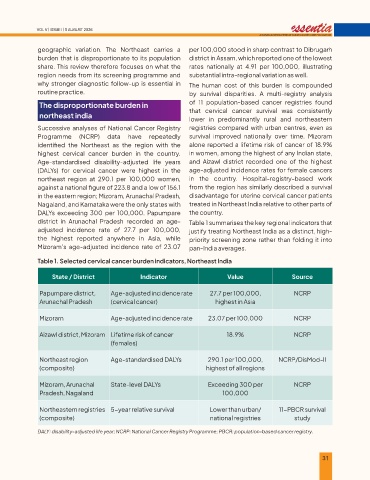
             district  in  Arunachal  Pradesh  recorded  an  age-  Table 1 summarises the key regional indicators that
             adjusted  incidence  rate  of  27.7  per  100,000,   justify treating Northeast India as a distinct, high-
             the  highest  reported  anywhere  in  Asia,  while   priority  screening  zone  rather  than  folding  it  into
             Mizoram’s  age-adjusted  incidence  rate  of  23.07   pan-India averages.

             Table 1. Selected cervical cancer burden indicators, Northeast India

                  State / District             Indicator                    Value                 Source


              Papumpare district,     Age-adjusted incidence rate     27.7 per 100,000,           NCRP
              Arunachal Pradesh       (cervical cancer)                 highest in Asia


              Mizoram                 Age-adjusted incidence rate     23.07 per 100,000           NCRP

              Aizawl district, Mizoram Lifetime risk of cancer              18.9%                 NCRP
                                      (females)

              Northeast region        Age-standardised DALYs          290.1 per 100,000,     NCRP/DisMod-II
              (composite)                                            highest of all regions

              Mizoram, Arunachal      State-level DALYs               Exceeding 300 per           NCRP
              Pradesh, Nagaland                                            100,000

              Northeastern registries  5-year relative survival       Lower than urban/      11-PBCR survival
              (composite)                                              national registries        study

             DALY: disability-adjusted life year; NCRP: National Cancer Registry Programme; PBCR: population-based cancer registry.


 30                                                                                                         31

