


Page 32 - Essentia Vol 5 Issue 1
P. 32
VOL V | ISSUE I | 5 AUGUST 2026            VOL V | ISSUE I | 5 AUGUST 2026
              A BIANNUAL NEWSLETTER OF ASSAM CANCER CARE FOUNDATION                                                                                                                                              A BIANNUAL NEWSLETTER OF ASSAM CANCER CARE FOUNDATION

             The  reasons  for  this  excess  burden  are       Nearly a decade later, the transition has not kept
             multifactorial.  They  include  persistent  high-risk   pace with the disease burden. Screening coverage
             HPV  infection,  region-specific  tobacco  use     remains very low, and many cervical cancer cases
             patterns, early age at first intercourse, multiparity   continue to be detected at advanced stages. This
             in  some  communities,  poor  uptake  of  organised   reflects not only the limitations of VIA but also low
             screening  and  geographic  barriers  that  delay   awareness,  discomfort  with  pelvic  examination,
             diagnosis  and  treatment.  Tribal  and  rural  women   sociocultural  barriers  and  weak  follow-up  after  a
             often  face  additional  barriers,  including  limited   positive screening test.
             health  literacy,  stigma  around  gynaecological   Community-based evidence shows why VIA alone
             examination, long travel distances and shortage of   is  not  enough  as  a  long-term  strategy.  HPV  DNA
             female providers.                                  testing has demonstrated much higher sensitivity
             From Visual Inspection to Molecular Testing: The   than VIA and Pap cytology, but programme success
             Evolving Screening Toolkit                         depends on what happens after a positive result. If
             India’s  national  screening  framework,  introduced   women do not reach colposcopy or biopsy, high-
             in  2016  under  the  Ministry  of  Health  and  Family   risk  cases  are  lost  from  the  pathway.  The  lesson
             Welfare’s   operational   guidelines   for   non-  is clear: HPV DNA is the stronger primary test, but
             communicable  diseases,  adopted  VIA  as  the     screening  only  works  when  referral,  colposcopy
             primary screening test because it was simple, low-  and treatment are functional.
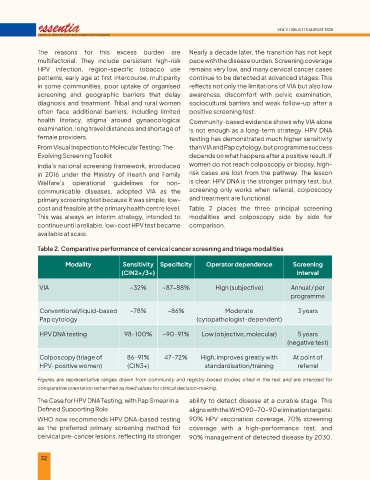
             cost and feasible at the primary health centre level.   Table  2  places  the  three  principal  screening
             This  was  always  an  interim  strategy,  intended  to   modalities  and  colposcopy  side  by  side  for
             continue until a reliable, low-cost HPV test became   comparison.
             available at scale.

             Table 2. Comparative performance of cervical cancer screening and triage modalities


                       Modality           Sensitivity  Specificity   Operator dependence          Screening
                                         (CIN2+/3+)                                                interval
              VIA                           ~32%       ~87–88%          High (subjective)        Annual / per
                                                                                                 programme

              Conventional/liquid-based     ~78%        ~86%                Moderate                3 years
              Pap cytology                                        (cytopathologist-dependent)

              HPV DNA testing             98–100%      ~90–91%      Low (objective, molecular)      5 years
                                                                                                (negative test)

              Colposcopy (triage of        86–91%      47–72%      High, improves greatly with    At point of
              HPV-positive women)          (CIN3+)                   standardisation/training      referral


             Figures  are  representative  ranges  drawn  from  community  and  registry-based  studies  cited  in  the  text  and  are  intended  for
             comparative orientation rather than as fixed values for clinical decision-making.

             The Case for HPV DNA Testing, with Pap Smear in a   ability  to  detect  disease  at  a  curable  stage.  This
             Defined Supporting Role                            aligns with the WHO 90-70-90 elimination targets:

             WHO  now  recommends  HPV  DNA-based  testing      90%  HPV  vaccination  coverage,  70%  screening
             as  the  preferred  primary  screening  method  for   coverage  with  a  high-performance  test,  and
             cervical pre-cancer lesions, reflecting its stronger   90% management of detected disease by 2030.


              32                                                                                                                                                                                                                      33

